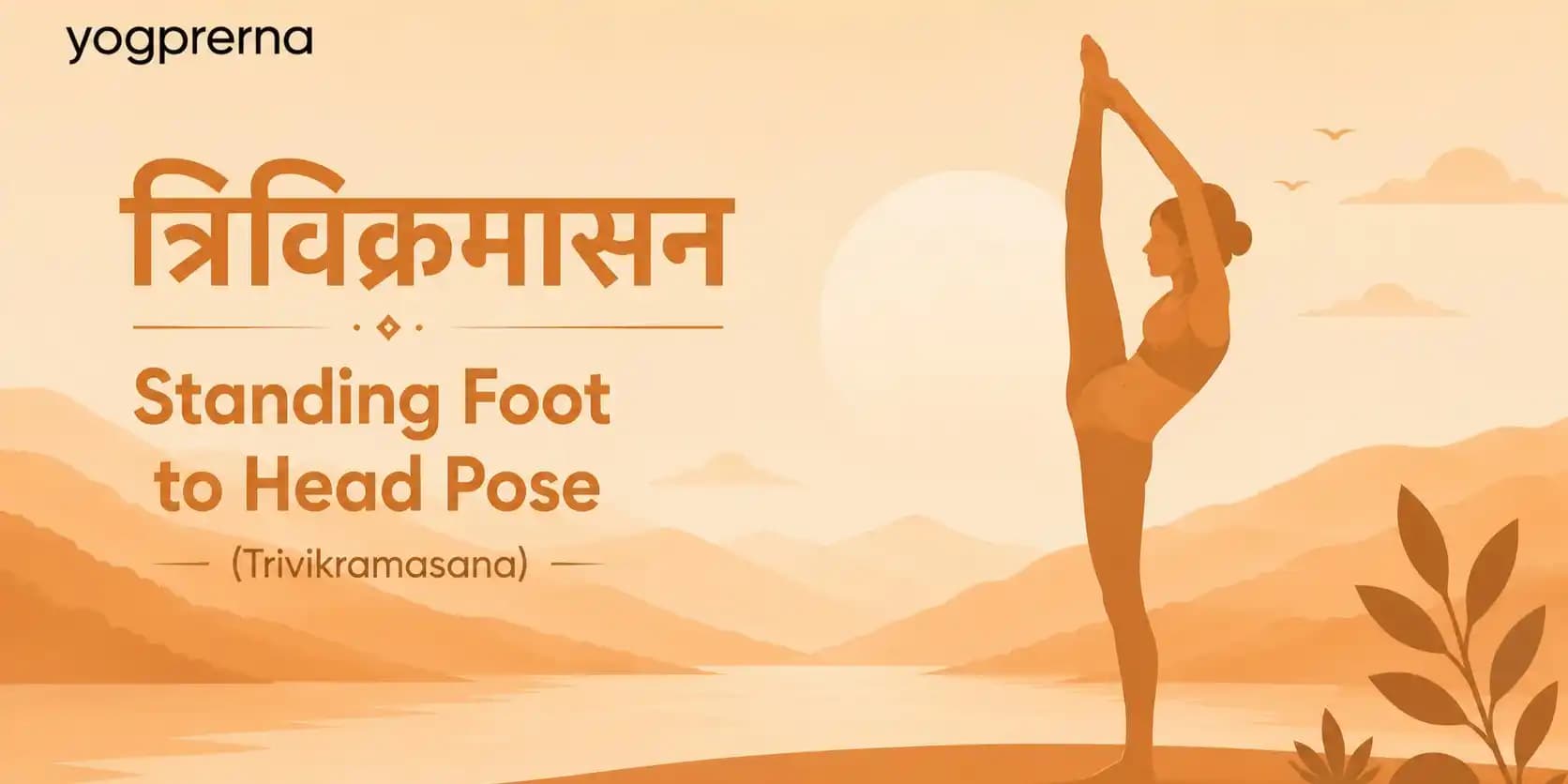
Trivikramasan
Named after the cosmic, space-defying strides of Lord Vishnu in his Trivikrama avatar, Trivikramasana is a masterpiece of advanced standing balance and hip opening. It represents the ultimate intersection of single-leg stability, deep hamstring flexibility, and core integration. Rather than just a showcase of flexibility, it demands absolute control and structural integrity from the standing foundation all the way up through the spine.
The structural foundation rests entirely on the single standing leg. The foot roots deeply into the mat, distributing weight evenly across the heel and toe mounds to establish a stable anchor. The quadricep of this standing leg engages powerfully to lift the kneecap and lock in stability, ensuring the knee does not buckle under the shifted center of gravity. The spine remains tall, long, and upright, resisting the natural tendency of the torso to lean excessively forward or collapse into the lower back.
The active expression of the posture relies on intense hip abduction and hamstring extension. As the lifted leg extends vertically upward along the side of the torso, the hip flexors and deep core muscles engage to drive the leg skyward. The arms assist by securely wrapping around the calf or ankle, gently hugging the extended leg close to the upper body to bring the foot toward the head.
To maintain equilibrium, the pelvis must stay as square and stable as possible, avoiding a dramatic twist that could destabilize the standing hip. The gaze is fixed firmly on a single, unmoving focal point (Drishti), which steadies the nervous system. The breath remains calm, smooth, and deeply diaphragmatic, keeping the muscles oxygenated during the intense stretch.
Delivers a profound stretch to the hamstrings, adductors, and glutes of the extended leg, while simultaneously opening the hip joints deeply.
Strengthens the ankles, calves, knees, and quadriceps of the standing leg by forcing the minor stabilizing muscles to constantly adjust.
Requires intense activation of the deep abdominal wall and psoas muscles to lift the leg and keep the torso upright against gravity.
The extreme balance requirement sharpens mental focus, quiets external distractions, and cultivates high-level proprioceptive awareness.
Alignment Note: A common pitfall is sacrificing the alignment of the standing leg—bending the knee or letting the foot roll inward—in an effort to force the lifted leg higher. Keeping the standing leg locked, straight, and vertically stacked over the ankle is paramount to protecting the joint structures.
| Variation | Purpose | Description |
|---|---|---|
| Wall-Assisted Stretch | Deconstructing the flexibility | Standing with the back flat against a wall provides structural support, allowing you to focus purely on the hamstring opening without balancing. |
| Strap-Assisted Lift | Accommodating tight hamstrings | Looping a yoga strap around the foot of the lifted leg extends your reach, allowing the spine to stay tall even if the leg cannot fully straighten. |
| Utthita Hasta Padangusthasana B | Foundational transition | Extending the lifted leg horizontally out to the side rather than vertically upward serves as the perfect intermediate step to build the necessary hip rotation. |
Standing Foot-to-Head Pose (Trivikramasana) is an advanced standing yoga pose that combines balance, flexibility, and strength by lifting one leg vertically toward the head while standing on the other leg.
No. Trivikramasana is an advanced yoga pose that requires good flexibility, balance, and strength. Beginners should first master foundational standing and flexibility poses.
The pose engages the hamstrings, hip flexors, quadriceps, calves, glutes, core, shoulders, and back muscles.
This pose improves flexibility, balance, core strength, hip mobility, posture, and concentration while strengthening the legs and increasing body awareness.
Hold the pose for 10–30 seconds on each side while maintaining steady breathing and proper alignment.
Yes, if your body is well-conditioned. Daily practice can improve flexibility and balance, provided you warm up properly and avoid overtraining.
Yes. It deeply stretches the hamstrings, hips, calves, and inner thighs while improving overall lower-body flexibility.
Common mistakes include bending the standing leg, rounding the back, forcing the lifted leg too high, locking the knee, collapsing the chest, and holding the breath.