Tadasana
Tadasana, commonly known as Mountain Pose, is often dismissed as "just standing." In reality, it is an active, high-engagement posture that establishes the structural blueprint for every other standing pose in yoga. By mastering the micro-adjustments required here, you train your body to find a neutral spine, balanced weight distribution, and functional posture that translates directly into everyday movements.
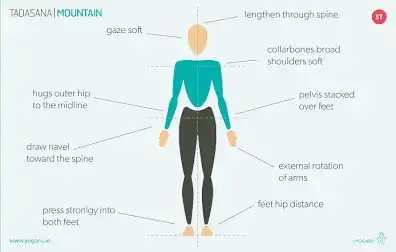
The foundation begins at the feet, where the big toes touch and heels stay slightly apart, ensuring the second toes remain parallel. Weight is distributed evenly across the four corners of the feet—the big toe mound, pinky toe mound, inner heel, and outer heel—while the arches actively lift.
Moving upward, the lower body provides a stable anchor. The quadriceps engage to lift the kneecaps without locking the joints, while the outer hips hug inward toward the midline. The pelvis rests in a neutral position, achieved by gently directing the tailbone toward the floor and drawing the lower abdomen upward and inward.
Realigns the skeletal system, helping to counteract the rounded shoulders and forward-head posture caused by prolonged sitting.
Active isometric engagement tones the abdomen, strengthens the arches of the feet, and builds stability in the ankles and thighs.
Balancing mindfully across the feet sharpens the nervous system's awareness of bodily alignment in space.
The combination of physical steadiness (Sthira) and ease (Sukha) helps quiet the mind and reduce stress.
Alignment Note: A common tendency is to slip into an anterior pelvic tilt, where the lower back arches excessively, the ribs flare out, and the buttocks push backward. True alignment requires keeping the front ribs knitted together and the pelvis stacked directly over the ankles.
| Variation | Purpose | Description |
|---|---|---|
| Urdhva Hastasana | Deep side stretch & shoulder opening | The arms reach straight overhead with palms facing each other, extending the stretch through the torso while keeping the feet grounded. |
| Wall Alignment | Postural feedback | Standing with the heels, sacrum, and upper back touching a wall provides immediate physical feedback on structural symmetry. |
| Closed Eyes | Advanced balance | Closing the eyes removes visual reference points, forcing the core and stabilizing muscles to rely entirely on internal proprioception. |
Mountain Pose (Tadasana) is a foundational standing yoga pose that promotes proper posture, balance, stability, and body awareness. It serves as the starting position for many standing yoga poses.
Mountain Pose helps improve posture, strengthens the legs and core, enhances balance, increases body awareness, supports better breathing, and builds a strong foundation for yoga practice.
Yes. Mountain Pose is one of the easiest yoga poses for beginners and is commonly taught in beginner yoga classes.
Beginners can hold Mountain Pose for 30–60 seconds. As your balance and endurance improve, you can gradually increase the duration.
Yes. Practicing Mountain Pose daily helps improve posture, stability, balance, and overall alignment.
Mountain Pose engages the feet, ankles, calves, thighs, glutes, abdominal muscles, back muscles, and shoulders.
Yes. Mountain Pose encourages proper spinal alignment, opens the chest, and helps correct poor posture caused by prolonged sitting or standing.
Yes. Mountain Pose strengthens the feet and legs while improving balance, coordination, and body awareness.