June 9, 2025
about 1 year ago
What is Dark Yoga? – A Complete Guide
Dark Yoga Meaning
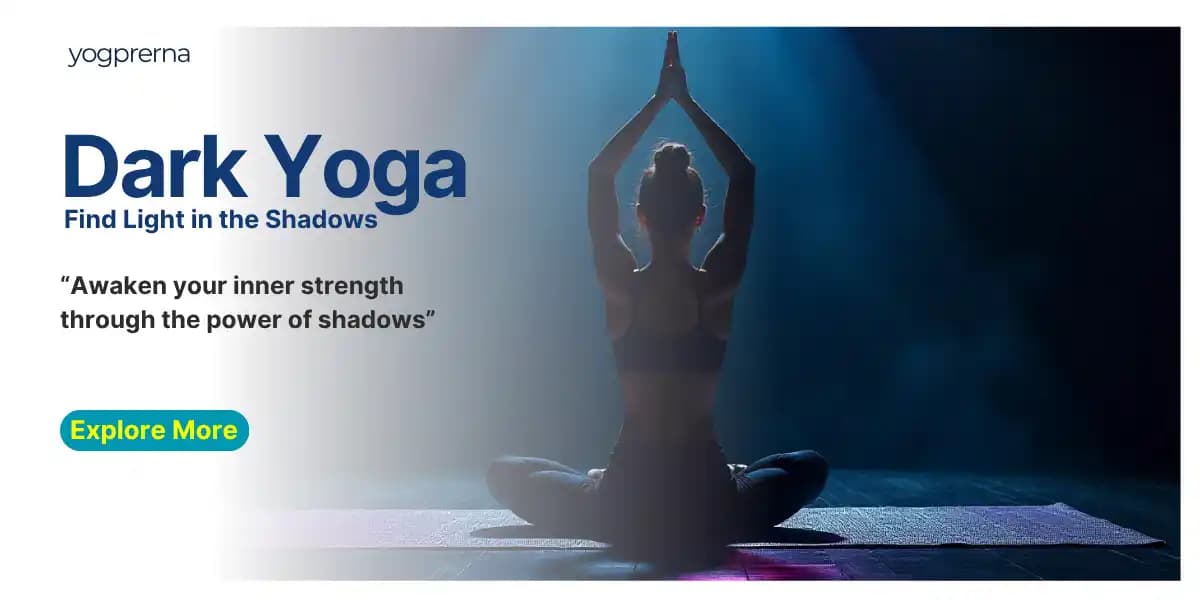
To prepare the mind and body, “Nathan Mills” introduces Dark Yoga in 2008, a practice that includes an hour of “static” yoga poses in a dark environment. Yoga in the dark or in silence can be for you if you nod in agreement. In contrast to other forms of yoga, dark yoga offers a number of advantages, including increased attention, a feeling of privacy, as well as a feeling of excitement. It all depends on how the lessons are taught.
The majority of yoga courses are designed to be peaceful spaces for relaxing exercise in a normally frantic life. But sometimes things don’t work out like that. Perhaps the background noise, the gym spectators, or the highway outside distract you.
And to make matters worse, you could be concerned that those nearby will overhear you huffing and puffing as the routines get more difficult. Regardless of the source, the noise can cause you to lose your focus and desire to put your mat away permanently.
What if, though, there was another choice? What if you had the choice to live in a world where no one could hear a sound you made and you were only bothered by quiet music or whispered instructions? Would you appreciate being completely alone in a room that was completely dark with only subtle ambient lighting?
Silent Yoga: In Pursuit of Happiness
Most of us have some knowledge of the peaceful, contemplative practice known as silent yoga. The focus of the practice is on breath, posture, and inner peace. This silent, dynamic flow of meditation is practiced.
Silent Yoga
Even while silent yoga can be done on its own, the next day’s Dark Yoga exercise is supposed to be done consecutively after this one. This allows the body and mind time to assimilate the physical and mental exercises from the previous night before performing another physical exercise to re-ignite any new awareness that was developed the previous night. Following the practice, students are urged (though not compelled) to observe silence for the entire day.
Guidance, a soundscape, and headphones are all absent. merely the practitioner and the age-old practice. The only difference between Sound Off Silent Yoga and that pure experience is a wireless topping. We are extremely serious about seeking peace. Audio distractions are blocked by Sound Off Silent Yoga.
How to perform Dark/Silent Yoga
These occasions are either held in parks after sunset for dark/quiet yoga lessons or in dimly lit spaces with soft LEDs in calming hues.
Dark/Silent Yoga
The teacher speaks into each student’s ear through a microphone, allowing participants to close their eyes and concentrate entirely on their mat without having to stretch to see or understand the teacher. Those who are concerned about being watched while exercising may be encouraged by the fact that it is unusual that anyone else will be watching the area either.
Though it is a sensory-heavy practice, silent yoga may not suitable for everybody. Silent yoga, on the other hand, can be exactly what you need if you enjoy being in a quiet environment and want to enjoy a deeper level of private reflection.
What does Dark/Silent Yoga do?
Dark yoga eliminates the one thing that so subtly permeates our lives: light. The brain is able to fully tune out all competitive and physical awareness because of this slight extraction. It improves the mind’s capacity for effortless movement inside the body.
Despite the fact that the goals are the same as in a regular yoga class, the darkness will make you realize that you don’t actually accomplish the egolessness you frequently believe you have. Both internal and external competition entirely disappear in the dark.
You must allow your mind and body to react as they ought to and as is necessary because you won’t be able to see your limbs. You must also acknowledge that whatever happened, was the right decision.
Beginners and experienced yogis alike can explore a different method of practice with Dark Yoga. It is an area conducive to inquiry and openness.
Dark Yoga is also perfect for Pratyahara
According to Patanjali’s Yoga Sutras, the fifth of The Eight Limbs of Yoga is pratyahara. Pratyahara is the technique of turning within and turning away from our senses, which keeps us connected to the outside world. We put ourselves to the test by really taking away one of our senses (seeing) in order to focus inside and calm the mind. You will learn how to withdraw and achieve profound self-awareness through this exercise.
Tips to perform Dark Yoga
Despite the fact that some studios offer yoga courses or workshops in the dark, you can end up practicing this on your own. When you initially begin doing yoga in the dark, remember these suggestions:
- Rather than just closing your eyes, choose a blindfold. This will make it impossible for you to just open your eyes if you start to feel uneasy or out of balance.
- It’s crucial to take your time when you first begin anything new, as with anything else. Starting with some simple poses will help you prevent injury because your balance and awareness of where you are will be altered. Start on your back or in a straightforward seated position. Consider how it might feel to be blind before attempting something challenging.
- Your mat will help you keep track of where you are in the space, but you should still take out any barriers that might get in the way if your position changes or you lose your balance at any point throughout your practice.
- You can try increasingly difficult poses and flows as you get more at ease practicing in the dark. Although your practice may not be as intricate as it is when you have your eyes open, it is still beneficial in many other ways.
May You Like – Super Brain Yoga || Top 10 Benefits of Yoga || Art of Yoga and Meditation
Frequently Asked Questions
Dark Yoga, introduced by Nathan, is a practice that involves an hour of
static yoga poses performed in a dark environment to prepare both the mind
and body.
Yoga in the dark requires focus and dedication. It helps you go inward,
enhances other senses, and allows for a deeper connection with the body and
breath.
Scientific studies show that darkness can influence human behavior and
cognitive function, potentially increasing susceptibility to deception or
mistakes at work. It can also reveal aspects of oneself that may typically
remain unnoticed.
In various spiritual perspectives, darkness often symbolizes the unknown,
challenges, or transformation. While some associate it with fear or danger,
others view it as a necessary counterpart to light that fosters growth and
self-discovery.